
Neuro-Finance
STAND IN OUR OWN WAY
SAY GOODBYE TO
PERCEIVED TRUTHS
In the stock market, many investors act on gut feeling, out of habit, and based on experiences that worked well in the past. Yet this often means trying to solve tomorrow’s problems with yesterday’s methods. Some believe that proven formulas will continue to work in new market phases — even though the framework conditions, speed, and complexity of the world have fundamentally changed. This creates a dangerous gap between what we feel and what is actually happening in the capital markets.
Neurofinance makes these patterns visible — and shows ways to break through them. INVIOS has developed a countermodel for this: consistent diversification, a global perspective instead of home bias, disciplined and cost-efficient implementation, rule-based risk management, and a long-term, data-based decision-making model that takes emotions into account without allowing them to determine decisions.
80% OF LOSSES
ARE CAUSED
BY HUMAN INVESTMENT MISTAKES
Emotional behavioral patterns often lead to poor decisions in capital markets. Typical traps include insufficient diversification through one-sided bets, home bias with a focus on familiar names rather than facts, impulsive trading with unnecessary costs, herd behavior and distorting frames, as well as an excessive short-term focus in which current news is given more weight than a clear, long-term plan.
An analytical and strategic investment approach systematically applies rational principles to counter emotional patterns. Structured diversification and a global perspective reduce risks and make use of return opportunities worldwide. Disciplined implementation, cost control, and rule-based rebalancing ensure a stable, predictable strategy without panic-driven or hype-driven transactions. A long-term, data-based decision-making model grounded in sound analysis improves decision quality and makes the investment process transparent and comprehensible.

WHEN NOTHING MOVES —
EXCEPT OUR PERCEPTION
Intuition is a powerful guide — fast, emotional, and often right. But when it comes to investing, it can mislead us: like this endless staircase, which appears to lead only upward for some and only downward for others. Both seem “real” — and yet they are an illusion. This is exactly how gut decisions arise in the stock market: from perception, not from perspective. Neurofinance makes these mechanisms visible — so that decisions are guided not by feeling, but by clarity and strategy.
EMOTIONAL BEHAVIORAL PATTERNS

-
01
Home Bias
Overweighting the domestic market and familiar names instead of relying on facts -
02
SHORT-TERM FOCUS
Emotional reactions to news instead of following a long-term plan -
03
LACK OF DIVERSIFICATION
One-sided bets, spontaneous stock selection, and high concentration risk -
04
OVERACTIVITY & COSTS
Frequent trading erodes returns — excessive trading and unnecessary fees -
05
HERD BEHAVIOR & FRAMING
Following the crowd, chasing trends, and relying on misleading reference points
ANALYTICAL AND RATIONAL INVESTMENT APPROACH

-
01
GLOBAL PERSPECTIVE
Investments based on opportunities, not proximity -
02
LONG-TERM, DATA-BASED DECISION-MAKING MODEL
Sound analysis, scenarios, and evidence instead of emotion -
03
STRUCTURED DIVERSIFICATION
Systematic diversification across asset classes, regions, and factors -
04
DISCIPLINED IMPLEMENTATION & COST CONTROL
Clear rules, low portfolio turnover, and a focus on net returns -
05
RULE-BASED REBALANCING & RISK MANAGEMENT
No panic selling, no hype buying — corridors and triggers
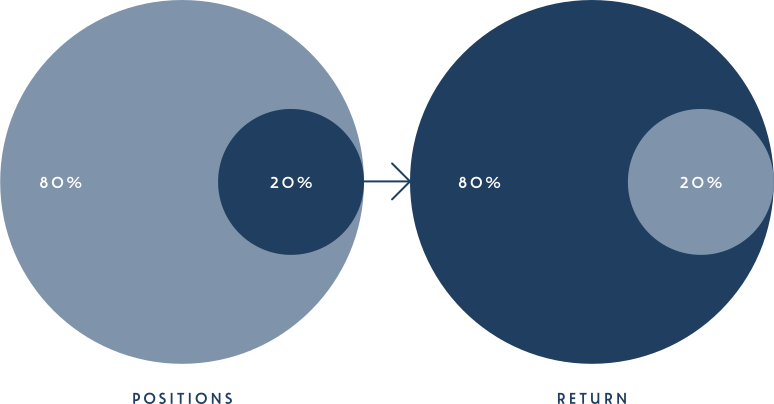
HOW DOES THE PARETO PRINCIPLE
APPLY TO YOUR INVESTMENT STRATEGY?
Pareto Principle shows that in many portfolios, a small number of positions generate the majority of returns, while targeted stock selection remains difficult. Broad diversification—for example, through ETFs—helps ensure that the few future top performers are included in the portfolio. For individual investors, the 80/20 rule also serves as a filter: A few key indicators often provide more insight than the daily flood of news.
Strategy, asset allocation, and risk management are therefore crucial—not the constant tracking of short-term price movements. Broad diversification across different asset classes significantly determines both volatility and returns, while a few serious mistakes in risk management can cause the greatest damage. The 80/20 principle directs attention to the truly effective levers: a few key decisions, a clear portfolio structure, and consistent risk limitation.
ABOUT INVIOS
FROM YOUR OWN INVESTMENT MISTAKES
The mind behind INVIOS is Nikolas Kreuz, a business graduate, founder, and managing director. He brings more than 40 years of capital markets experience, including over 25 years in senior asset management positions — at Deutsche Bank, UBS, and DZ Privatbank, as well as serving as Chief Investment Officer at two German state banks.



CONTACT
OF YOUR OWN INVESTMENT DECISIONS
Others sell stock market dreams. We show you where the typical thinking errors lie — and how to avoid them. The result: greater clarity, greater security, and greater confidence in your decisions.
Do you have questions or would you like a confidential conversation? Contact us via the contact form.